
 Building upon the success of the DwarfLab Dwarf II, the Dwarf 3 is a bit larger and offers state-of-the-art hardware upgrades, which include optics, sensors and increased processing power. Its refractor optical design features a 6-element apochromatic telephoto lens with a periscope mechanism, a 35 mm aperture, 150 mm focal length and an f/4.3 focal ratio. The wide lens aperture is 3.4 mm and its focal length is 6.7 mm.
Supplanting the Dwarf 3 in terms of size, the Dwarf mini, introduced in late 2025, now reigns as the physically smallest and lightest smart telescope available. At just 68 cubic inches and 1.85 pounds, it will fit in most jacket pockets with room to spare. Having a telescope barrel instead and 6 apochromatic optical lenses, it is a refractor with the same 150 mm focal length as the Dwarf 3, but a 30 mm aperture and f/5 focal ratio. The wide-angle lens is the same: 3.4 mm aperture and 6.7 mm focal length.
 Automatic setup simplifies astrophotography of the Milky Way, galaxies, nebulae, Sun and Moon. The dual color cameras accommodate exposure times of up to 90 seconds telephoto/30 seconds wide-angle for the Dwarf mini and 60 seconds telephoto for the Dwarf 3. Shooting modes include Photo, Video, Astronomy, Burst and Time-lapse. The Dwarf 3's 35 mm telephoto lens gathers double the light of the Dwarf II and the Sony IMX678 sensor has 2.0 mm pixels, which is a size increase of more than 90%. The Dwarf mini uses a Sony IMX662 image sensor with 2.9 mm pixels. Four image formats are supported: PNG, JPG, FITS and TIFF. Storage capacity of the Dwarf 3 is 128 GB and 64 GB for the Dwarf mini.
EQ (equatorial) mode is recommended for exposure times of 15 seconds and longer to prevent field rotation, which is the rotation of objects around the field of view center point while tracking. By tilting the Dwarf and following a calibration sequence, the alt-azimuth mount is effectively converted into an equatorial mount that is aligned with the Earth's polar axis.
Your smart device functions as both the eyepiece and the telescope's control center. Images are landscape-oriented with a telephoto resolution of 3840 x 2160 and a wide-angle resolution of 1920 x 1080, resulting in fields of view of 2.95° x 1.66° x 3.38° diagonal and 40.48° x 30.36° x 50.6° diagonal, respectively, with rotation angles of 240° lens/340° base, for the Dwarf 3. For the Dwarf mini, resolution is 1920 x 1080 with fields of view of 2.14° x 1.20° x 2.45° diagonal telephoto and 45.06° x 25.93° x 50.59° diagonal wide-angle, with 225° lens/360° base rotation angles.
Built-in filters improve image quality. For astronomy and low-light applications, the Astro filter encompasses the infrared spectrum (430-690 nm) to increase nebula contrast. The Dual-Band filter is designed to reduce city light pollution/Moonlight in the OIII (500.7 nm), Hβ (486 nm) and Hα (656.3 nm) range and is ideally suited for emission nebulae. The Dwarf 3 has a VIS filter that covers visible light wavelengths (430-650 nm) to optimize daytime photography. The Dwarf mini can auto-capture darks using its Dark-Frame filter function to minimize thermal noise.
One-click shooting simplifies the process yet every aspect can be precisely controlled manually. Use the Schedule Shooting feature for fully autonomous astroimaging sessions and either create a plan from scratch or select an object from the built-in Sky Atlas, which suggests the best targets daily. Background imaging continues if the app is minimized or closed.
Complementary post-processing features automatically enhance images. MegaStack enables you to select and combine the best frames captured during multi-night observations to produce a single, highly detailed image. Faint objects, like distant galaxies and nebulae, benefit the most from this process. Striking improvements in contrast, detail and color of deep-sky photos are achievable with Stellar Studio, which uses AI for noise reduction. AI is also used for stitching blend of scenery to create gigapixel panoramas.
Wide-angle and telephoto cameras work together seamlessly to capture close-up views of wildlife. The Dwarf 3's Auto Capture Mode can detect a bird and track it during flight until it's out of sight, while the high-resolution, high-bitrate recording capability delivers crisp, fluid video.
At home in a variety of climates, the Dwarf 3 resists moisture and dew, and dust.
The Dwarf 3 was released in late 2024. Its battery capacity is 4 hours in Astro mode, it measures 8.7 in. x 5.6 in. x 2.6 in. (125 cu. in.) and weighs 3.0 lbs. Solar filters with a protective pouch are supplied along with a padded carrying case; a tripod is not included. The diminutive Dwarf mini's battery is rated for 4 hours in Astro mode, measures just 7.23 in. x 3.95 in. x 2.39 in. (68.27 cu. in.) and weighs only 1.85 lbs. A solar filter is included; a water-repellent/shock-absorbing storage bag is separately available. Specifications are listed below.
To learn more about the DwarfLab Dwarf 3 and Dwarf mini and for updated information, visit the DwarfLab† website.

Image Credit: DwarfLab
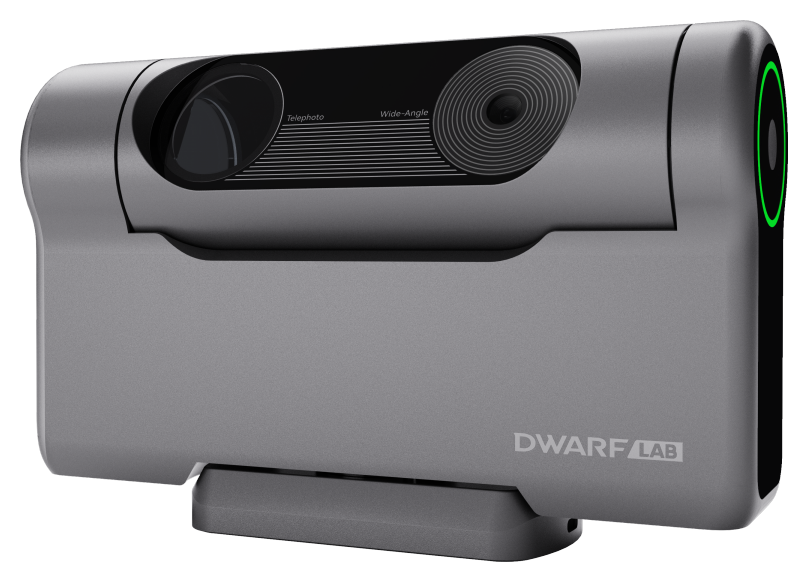
Image Credit: DwarfLab
Product
Overviews, which are based solely on manufacturer-supplied data, have been
reviewed by the manufacturers, provide more detail than Product
Reviews and do not include personal opinion or AI generated content.
† I
do not earn a commission if you buy through links on this site.
46166